
Trinity County Bench Warrant Lookup
Trinity County bench warrants are issued by the Superior Court in Weaverville when someone fails to appear for a scheduled hearing or violates the conditions of their release. This is one of the smallest and most rural counties in California with limited court resources. The court offers a unique option where paying off a warrant can lead to its recall without an arrest. Understanding how bench warrants work in this remote mountain county can help you handle the situation properly.
Trinity County Quick Facts
Trinity County Superior Court Details
The Trinity County Superior Court is located at 11 Court Street in Weaverville, CA 96093. The court phone number is (530) 623-1208. This small courthouse handles all legal matters for the county, including criminal cases that result in bench warrants. With fewer than 15,000 residents, Trinity County has one of the smallest court systems in California.
Because of its size, the court does not have the online search tools that larger counties offer. There is no web portal to check case status or warrant information. If you need to know whether you have a bench warrant from Trinity County, you will need to call the court or visit in person. The staff may be able to help with basic questions about your case status.
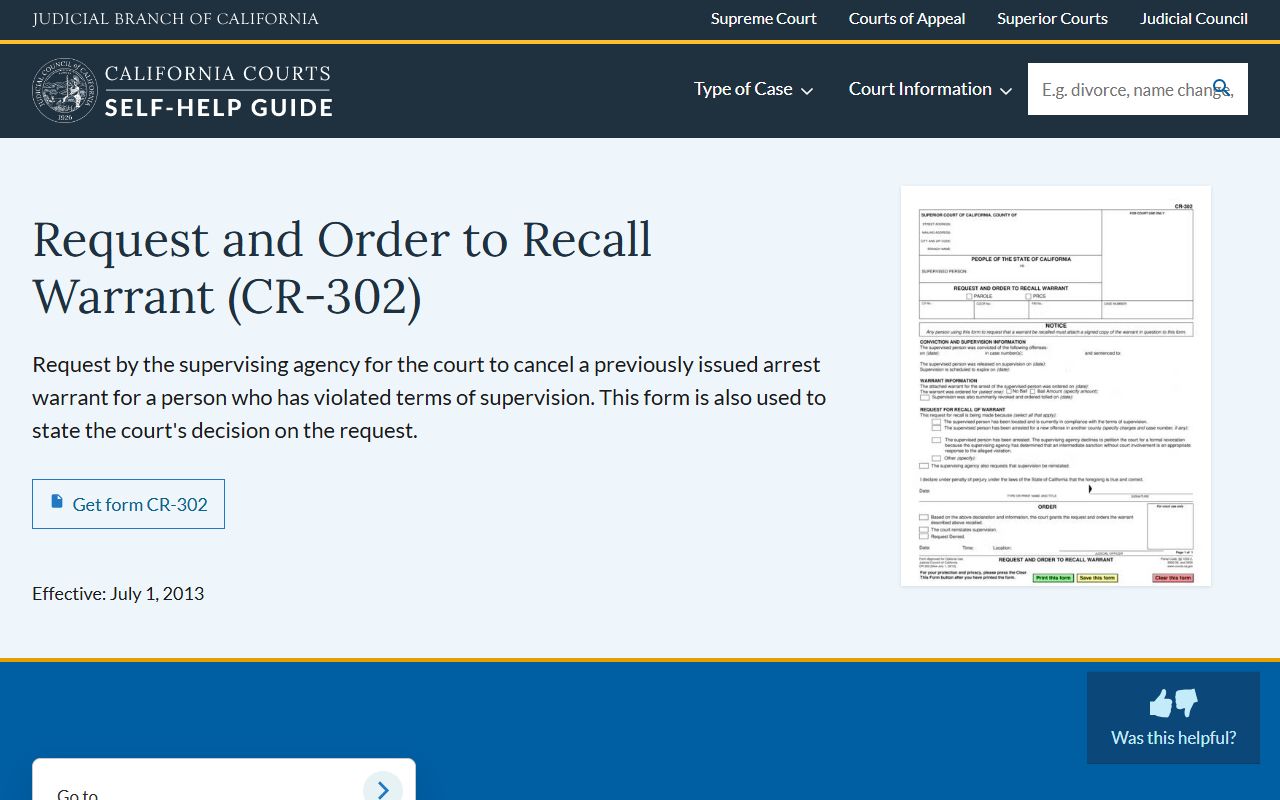
The California Judicial Council form shown above is used to request a warrant recall. Form CR-302 is available at courts.ca.gov and applies in Trinity County just as it does statewide. This form requires attaching a copy of the original warrant.
Paying Off Trinity County Warrants
Trinity County has an interesting option for some warrants. The court FAQ states: "Once the warrant is paid, the Court will recall the warrant to avoid an arrest." This means that in certain cases, you may be able to pay the fine or bail amount without being taken into custody. This is not available for all warrants, but it is worth asking about.
This option typically applies to infractions and minor misdemeanors where a fine is the main penalty. For more serious charges, you will still need to appear before a judge. Call the court at (530) 623-1208 to find out if your specific warrant can be handled this way. Staff can tell you the amount owed and how to pay.
Payment can usually be made in person at the courthouse. Some courts accept credit cards. Cash and money orders are also common payment methods. Once you pay, the court recalls the warrant and closes the case. You avoid the arrest and booking process entirely. This can save a lot of time and stress if your case qualifies.
Note: Serious charges and felony warrants cannot be resolved this way and require a court appearance.
Trinity County Sheriff Warrant Services
The Trinity County Sheriff can be reached at (530) 623-2611. They handle warrant enforcement across this large and rural county. When the court issues a bench warrant, the Sheriff enters it into the statewide system. Any law enforcement officer in California can then see the warrant when they run a name check.
If you are in Trinity County and need to turn yourself in, you can go to the Sheriff's office. They will process the arrest and hold you until you can see a judge. In this small county, wait times can vary. The court does not hold criminal matters every day, so you might have to wait longer than in a larger county. Planning ahead and arriving early in the week can help.
The Sheriff's office can also answer general questions about the warrant process. They cannot tell you for certain whether you have a warrant over the phone in most cases. You may need to come in person for a definitive answer. Bring identification with you.
Resolving Trinity County Bench Warrants
If you cannot pay off your warrant directly, you have other options. The traditional approach is to surrender yourself. Go to the courthouse or the Sheriff's office. Let them know you are there to turn yourself in on a bench warrant. They will process you and schedule a hearing before a judge.
At the hearing, the judge will decide what happens next. They may recall the warrant and release you with a new court date. They might set bail. In some cases, they could keep you in custody. Having a lawyer can help your chances of a favorable outcome. An attorney can explain your situation and present any mitigating factors.
For misdemeanor cases, Penal Code Section 977 often allows your lawyer to appear in court on your behalf. This means you might not have to personally surrender. Your attorney can ask the judge to recall the warrant while you stay home. Many people prefer this option when it is available.
Failure to Appear Consequences in Trinity County
Missing your court date in Trinity County triggers a bench warrant under Penal Code 978.5. The judge can sign the warrant that same day. From that moment, you can be arrested anywhere in California. The warrant does not expire. It stays active until you deal with it.
Failing to appear is also a crime on its own. Under Penal Code 1320, willfully missing court when released on your own recognizance is punishable as a separate offense. If you do not show up within 14 days, the law assumes you meant to skip court. Felony bail cases face even tougher rules under Penal Code 1320.5. Fines can go up to $10,000 for felony failure to appear.
Courts can also add a civil assessment of up to $300 under Penal Code 1214.1. Vehicle-related cases may lead to a DMV hold on your license. The problems compound over time.
Trinity County Court Contact Information
Here is the key contact information for Trinity County warrant matters.
- Court: (530) 623-1208
- Address: 11 Court Street, Weaverville, CA 96093
- Sheriff: (530) 623-2611
Weaverville is a small town in the Trinity Alps region. The courthouse serves the entire county. If you are traveling from outside the area, plan for the drive. The town is about an hour west of Redding on Highway 299. Court hours follow standard weekday schedules, but criminal matters may not be heard every day. Call ahead to find out when the court handles warrant surrenders.
Nearby California Counties
Not sure if your warrant is from Trinity County? These neighboring counties each have their own court systems.